
Unification and Disunity: Philosophy of the Socialist Crisis in Yugoslavia
 12. 5. 2026
,
10:30
12. 5. 2026
,
10:30  Large Meeting Hall of the Institute of Theoretical and Applied Mechanics and the Institute of History of the CAS, Prosecká 809/76, Prague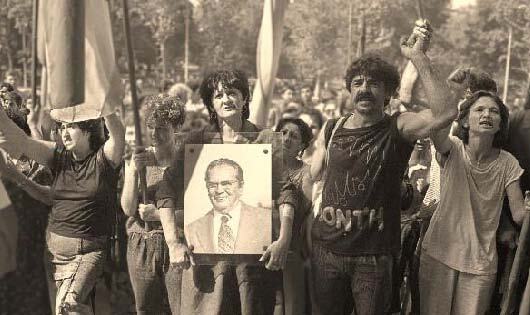
You are cordially invited to the lecture Unification and Disunity: Philosophy of the Socialist Crisis in Yugoslavia by Marija Martinović (CEFRES / Sorbonne University), organised by the Institute of History of the Czech Academy of Sciences, which will take place on 12 May 2026 at 10:30 AM in the Large Meeting Hall of the Institute of Theoretical and Applied Mechanics and the Institute of History of the CAS.
This thesis examines Yugoslav socialism from 1945 to 1991 as a philosophical process shaped by the tension between unification and disunion. Rather than interpreting the Yugoslav crisis only as a political or economic failure, it approaches it as the progressive exhaustion of a lived ideology: one that aimed to transform social reality while being continuously transformed by it. Socialism is analyzed as an ensemble of concepts, practices, and collective imaginaries in which philosophy was inseparable from everyday political life. The postwar period is understood as a moment of radical invention, marked by the emergence of a new collective subject forged through revolutionary struggle, reconstruction, and the break with Soviet orthodoxy. Workers’ self-management occupies a central place as an embodied socialist praxis, simultaneously expressing emancipatory aspirations and generating new forms of discipline, coordination, and control. From the 1960s onward, critical Marxist thought reveals growing tensions between philosophical autonomy and institutional oversight. Intellectual debates around freedom, morality, and critique expose the limits of ideological pluralism within the Yugoslav system. The constitutional reforms of 1974 appear as a paradoxical effort to re-legitimate socialism while crystallizing its internal contradictions. The final years are approached through the intertwined dynamics of crisis, nationality, and memory, as the disintegration of the collective project redirected philosophical reflection, artistic production, and cultural memory toward negotiating both loss and continuity. Yugoslav socialism thus endures as an unresolved legacy whose paradoxes continue to shape post-Yugoslav thought and identity.
Marija Martinović is a PhD student in philosophy and Slavic studies at the École doctorale 20 at Sorbonne University, affiliated with the Eur’Orbem research unit (UMR 8224, CNRS/Sorbonne University). A member of the “Passage” junior research laboratory within Eur’Orbem, she is writing a thesis under the supervision of Philippe Gelez and Daniel Baric entitled Unification and disunity: philosophy of the socialist crisis in Yugoslavia (1945–1990).
12. 5. 2026
,
10:30
Large Meeting Hall of the Institute of Theoretical and Applied Mechanics and the Institute of History of the CAS, Prosecká 809/76, Prague 