
Villa Lanna. The Story of a House and Its People
 Author:
Patrik Wirkner, Milan Hlavačka
Author:
Patrik Wirkner, Milan Hlavačka
 Year of publication:
2025
Year of publication:
2025
 Publisher:
Historický ústav
Publisher:
Historický ústav
 ISBN:
978-80-7286-441-6
ISBN:
978-80-7286-441-6
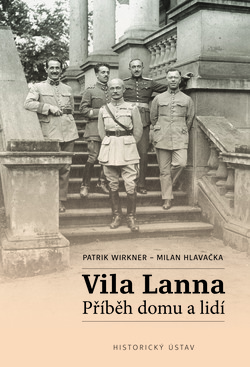
Villa Lanna is widely regarded as the most significant surviving example of Neo-Renaissance architecture in Prague. Vojtěch Lanna Jr. used the building from the early 1870s until 1909. In 1913, his son sold the property to Alois Potůček, the mayor of Bubeneč. It was later acquired by Vojtěch Zikmund, a mineral oil entrepreneur from Karlín. Despite being subject to partial monument supervision during the First Republic and undergoing several renovations, Villa Lanna's subsequent fate and owners in the 20th century remained relatively obscure for a considerable period. Over the years, the villa has been given a number of nicknames based on its owners, including Villa Lanna, General Pellé's Villa, General Mittelhauser's Villa and Villa Valdštejn (also known as Palais Waldstein or Villa Waldstein), in reference to Adrienna Tůmová (married name Waldstein-Wartenbergová). For a time, the residence was known as the Polish Villa, as it served as the Polish consulate's headquarters in the aftermath of the Second World War. Eventually, the institution was returned to its original name, Villa Lanna, although current employees of the Czech Academy of Sciences refer to it by the more informal name of 'Lannovka'. Follow in the footsteps of Villa Lanna to discover that it is not only an exceptional architectural gem, but also an important historical symbol of Prague and the Czech Republic, the fate of which it has crossed several times.
